
Alternative Sentencing Overview
The Alternative Sentencing Bureau is operated by the San Mateo County Sheriff's Office Corrections Division from the Maple Street campus. The research identifies it as a program office for the Sheriff's Work Program, Sheriff's Electronic Monitoring Program, and Work Furlough. It is not a bed-rated jail building, not the county booking desk, and not a public roster of people housed in cells.
The bureau matters for inmate-search work because some low-risk, minimum-security offenders may serve all or part of a court sentence through approved alternatives instead of full-time jail confinement. The Sheriff's Work Program began in 1983 as an alternative to high-cost incarceration. Electronic Monitoring began in the late 1990s, and Work Furlough began in the early 2000s. Since July 1, 2021, applicants have not been required to pay program fees associated with participation.
The San Mateo County Corrections Division page lists the Alternative Sentencing Bureau as part of the local corrections system.
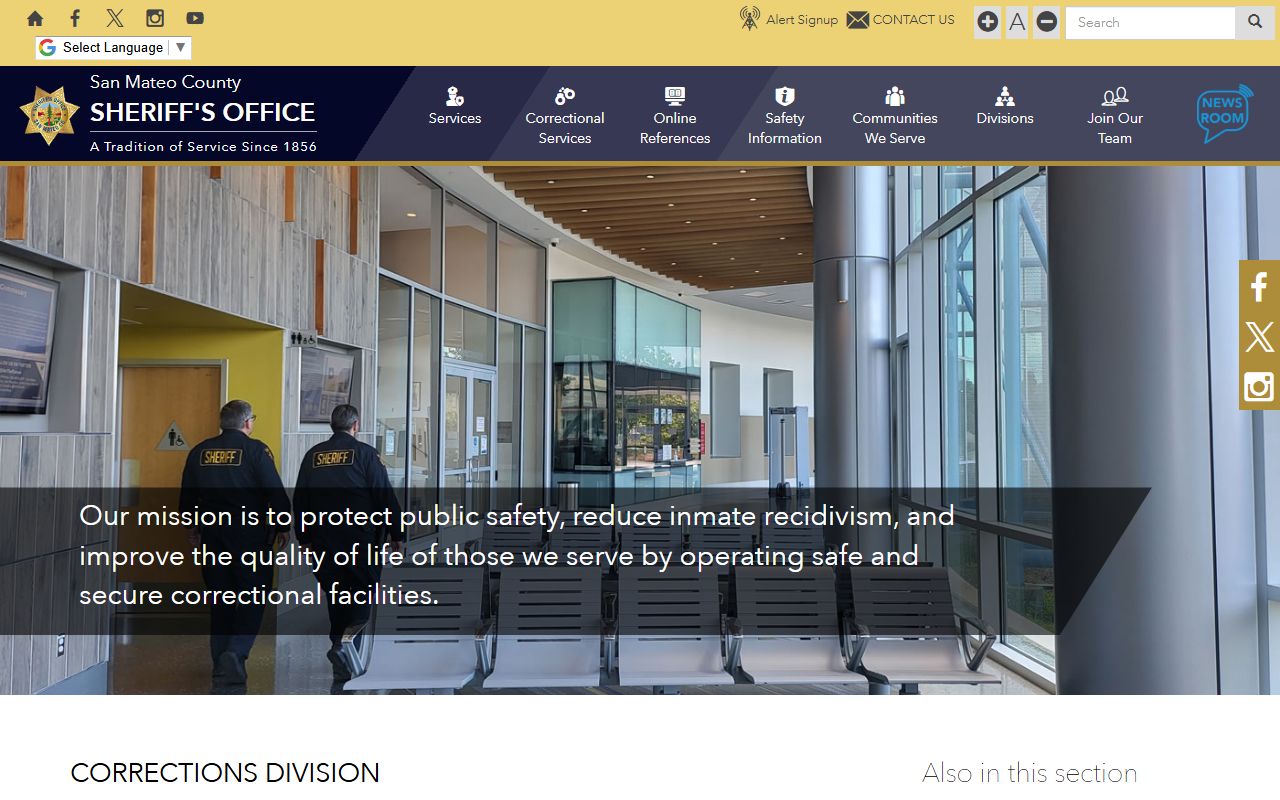
The image helps place the bureau among sheriff corrections locations, while the page text should still treat it as a program office rather than jail housing.
Alternative Sentencing Capacity
No jail-bed capacity applies to the Alternative Sentencing Bureau in the research. The facility map describes it as a program, not a bed-rated detention building, and no public capacity number was captured. Rated beds, current inmate population, and jail-housing statistics do not fit the bureau. Capacity in a program sense depends on court approval, staff review, eligibility, supervision resources, and compliance rules.
The no-fee fact should not be expanded into a claim that every cost related to a case is waived. Fines, restitution, court assessments, treatment costs, or employment obligations can exist outside the sheriff program fee statement.
Alternative Program Lookup
Alternative Sentencing Bureau lookup is not the same as a normal jail roster search. The first question is whether a court has recommended the person for a program. The research says applicants must call at least five days after a court recommendation and provide the court case number, surrender date, and sentence length. The Alternative Sentencing Sergeant ultimately approves or disapproves participation.
- Confirm that the court recommended the Sheriff's Work Program, Electronic Monitoring, or Work Furlough.
- Wait at least five days after the recommendation before calling, as stated in the research.
- Call the bureau with the court case number, surrender date, and sentence length.
- Bring official government photo ID and a completed application to the appointment.
If the person has not yet been placed in a program or may still be in jail custody, use the San Mateo County inmate locator first. The county locator may show custody status, facility location, pending charges, next court date, and bail amount if the person is in sheriff custody and the record is public.
Alternative Sentencing Contact
Use the bureau phone number for program appointment and eligibility routing after the court recommendation. Do not use it as a substitute for emergency reporting, court clerk questions, or a general public-record request. The office is located on the Maple Street corrections campus.
Alternative Sentencing Bureau
1300 Maple Street
Redwood City, CA 94063
(650) 599-3030
Sheriff's Work Program, Electronic Monitoring, and Work Furlough office.
Alternative Sentencing Appointments
Because the bureau is a program office, the normal facility-page visitation concept becomes an appointment and reporting concept. The research does not identify public visiting hours for this office. It identifies post-recommendation calling, appointment-day ID, punctual arrival, and a completed 2023 WF-EMP application as the key public-facing steps.
| Process item | Timing or requirement | Source use |
|---|---|---|
| Call after recommendation | At least five days after the court recommendation. | Program application routing. |
| Information to provide | Court case number, surrender date, and sentence length. | Appointment screening. |
| Appointment-day items | Government photo ID and completed application. | Program intake, not jail visiting. |
Participants should be on time and follow staff instructions. Note: Program approval is not automatic merely because a court recommendation exists.
Alternative Sentencing Programs
The Sheriff's Work Program lets court-approved low-risk, minimum-security offenders perform manual labor instead of serving full-time confinement. Electronic Monitoring uses electronic equipment for approved supervision outside full-time jail housing. Work Furlough can allow approved participants to work while serving a sentence. Research notes that stable housing may be required, and some programs may require full-time employment, full-time school, or treatment participation.
| Program | What the research supports |
|---|---|
| Sheriff's Work Program | Manual-labor alternative for court-approved low-risk, minimum-security offenders. |
| Electronic Monitoring | Supervised alternative that began locally in the late 1990s. |
| Work Furlough | Approved custody alternative tied to work, school, or treatment participation. |
These programs reduce reliance on full-time jail beds for eligible participants, but they do not erase the court case. Violations, noncompliance, new arrests, or court orders can change a person's status and return them to standard custody.
Alternative Program Fees
The clearest money fact in the research is that effective July 1, 2021, applicants are not required to pay fees associated with the program. That statement applies to the Alternative Sentencing Bureau program fees. It does not authorize claims about fines, court-ordered restitution, treatment-provider charges, transportation, employment costs, or other case-related obligations.
| Cost item | Captured rule |
|---|---|
| Program fees | No fees required since July 1, 2021, according to the research. |
| Jail commissary | Not a normal bureau function because this is not a bed-rated jail facility. |
| Court obligations | Verify with court records or counsel; not resolved by the bureau capacity note. |
Program Record Boundaries
Alternative Sentencing Bureau status sits between jail custody and court case administration. A jail locator record may exist before placement, during a custody return, or if the participant is still in sheriff custody. Formal charges, sentence terms, surrender dates, and court orders belong to the court record. Program approval, denial, supervision rules, and appointment steps belong to sheriff program staff.
For public records, the sheriff webform is the better route when a requester needs releasable policy or booking material that is not available online. People requesting their own reports, involved parties, and attorneys are routed by the sheriff's own webform instructions to a separate report/request process and recordsrequest email with ID or authorization. For a deeper custody-record overview, see San Mateo County jail inmate records.
Note: Confirm program status with the bureau and court because approval, compliance, and custody status can change quickly.